Showing posts with label UK economy. Show all posts
Showing posts with label UK economy. Show all posts
Monday, November 28, 2011


Tuesday, October 11, 2011
UK production data - clear signs of a slowing economy
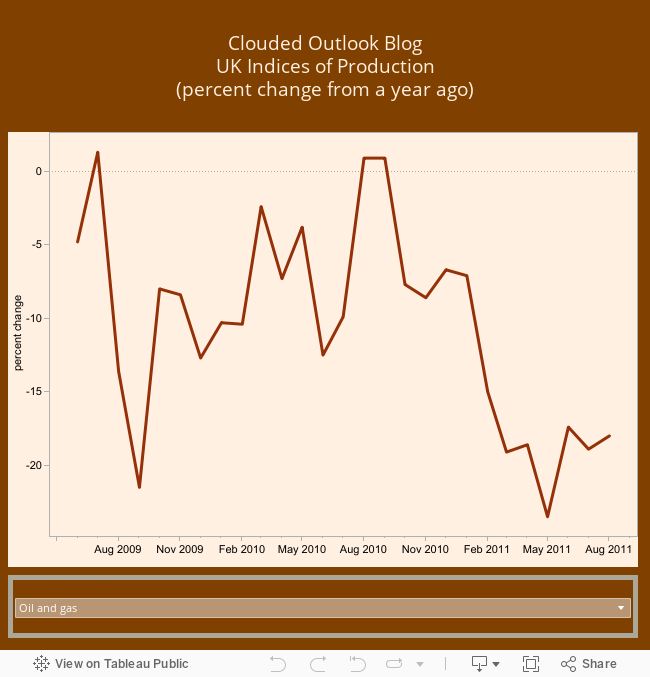
The headline index of production, so are other key sectors, such as capital goods. Other sectors, such as intermediate goods, energy and oil and gas are actually shrinking.
More evidence of an oncoming recession.
Tuesday, September 27, 2011

Friday, September 23, 2011
A genuine exit strategy from the crisis
In 2010, the global economy enjoyed steady if unremarkable growth. By the third quarter of 2011, it teetered on the edge of recession. The post-crisis recovery lasted barely 2 years. Moreover, in many advanced economies, growth proved insufficient to ensure that GDP reached its pre-crisis level.
How did things get so bad so quickly? The answer lies in the public sector balance sheets of advanced economies.
When banking sector difficulties turned into an economic downturn, tax revenues took a hit, while expenditures on unemployment benefits rose. In some countries, the revenue decline was exacerbated by a long-standing dependence on asset prices and financial bubbles as sources of taxes.
Politicians believed that they could buy their way out of recession. With revenues already weakening due to the economic downturn, governments tried to stimulate activity by cutting taxes and increasing expenditures, pushing fiscal deficits up to levels not seen since the Second World War. With rising deficits came rising debt levels, which were already extremely high in many socialist leaning European countries.
How did things get so bad so quickly? The answer lies in the public sector balance sheets of advanced economies.
When banking sector difficulties turned into an economic downturn, tax revenues took a hit, while expenditures on unemployment benefits rose. In some countries, the revenue decline was exacerbated by a long-standing dependence on asset prices and financial bubbles as sources of taxes.
Politicians believed that they could buy their way out of recession. With revenues already weakening due to the economic downturn, governments tried to stimulate activity by cutting taxes and increasing expenditures, pushing fiscal deficits up to levels not seen since the Second World War. With rising deficits came rising debt levels, which were already extremely high in many socialist leaning European countries.
Thursday, September 22, 2011
Lets squeeze the rich
Before we address the heated question of tax policy and the super rich, let is start with a question......
In fiscal year 2010-11 how many people in Britain earned more than £1 million a year? Before you answer, here are three background facts. First, there are 31.5 million income tax payers in the UK. Second, their total tax liability was £159 billion. Third, the average nnual payment for all tax payers was £5,220.
So what is your answer? Well, according to the Office of National Statistics, the number is just 13,000. Their tax liability, on the other hand, was a little more impressive. Again, in 2011, it amounted to little over £12 billion. A tidy little sum, but still only a fraction of the total economy-wide income tax liability.
In fiscal year 2010-11 how many people in Britain earned more than £1 million a year? Before you answer, here are three background facts. First, there are 31.5 million income tax payers in the UK. Second, their total tax liability was £159 billion. Third, the average nnual payment for all tax payers was £5,220.
So what is your answer? Well, according to the Office of National Statistics, the number is just 13,000. Their tax liability, on the other hand, was a little more impressive. Again, in 2011, it amounted to little over £12 billion. A tidy little sum, but still only a fraction of the total economy-wide income tax liability.
Monday, March 14, 2011
Inflation - creeping higher month by month
 Producer prices were up again in March.
 The trend is remorseless and it is due to monetary policy. Rates are too low. Prices are responding as expected. They are going up.
Wednesday, March 9, 2011
Tuesday, March 8, 2011
Young men exit the labour market in record numbers
 The last decade might have been boomtime for bankers, but for many young men, it was a very lean period. Labour force participation rates for 16-24 year old males fell by around 7 percent. Before you ask, that number excludes those in full time education.
The decline in participation seems to coincide with the election of Blair, Brown and the New Labour crew in 1997. During the latter years of the Major goverment, participation was actually increasing.
The recent recession appears to have accelerated the process of male youth economic inactivity. Last year, the participation rate fell dramatically
Here is a question - how are those inactive young men surviving? Perhaps, they are all safely at home with mum. Or perhaps not.
Monday, February 28, 2011
Andy Sentance explains why rates have to rise
Andy Sentance lays out the case for a rate rise in a recent speech entitled - Ten good reasons to tighten:
Perhaps the UK economy is really slowing down again
The Q4 GDP number looked like a weather-generated aberration. My view, for what it is worth, was that the UK economy would recover quickly this quarter. While I thought growth would continue to be anemic, I also believed that the UK GDP numbers would crawl into positive territory.
However, a couple of recent stories have recently made me reconsider this optimism.
However, a couple of recent stories have recently made me reconsider this optimism.
Thursday, February 24, 2011
RBS exercises restraint
First the bad news. RBS chairman - Sir Philip Hampton, conceded that last year more than 100 employees received compensation of at least £1 million. The good news is that the number was lower than the preceding year.
There is even more good news - bonus pool was less than £950 million. It could have been so much higher.
Stephen Hester, chief executive, summed it up perfectly "We have tried to exercise restraint."
There is even more good news - bonus pool was less than £950 million. It could have been so much higher.
Stephen Hester, chief executive, summed it up perfectly "We have tried to exercise restraint."
Wednesday, February 23, 2011
The MPC are digging up old quotes rather than hiking rates
The monetary policy committee has started to communicate in aphorisms. Both David Miles and Adam Posen cracked open a dictionary of quotes in order to spice up recent speeches on the state of UK monetary policy.
The tyranny of debt dynamics

Debt charts can often scare the crap out of you. If the line heads upwards, dark images of financial ruin and bankruptcy come to mind.
David Miles, external MPC member, produced this alarming picture in a recent speech. It highlights the UK debt-to-GDP ratio since the middle of the 19th century. If one includes the debts of recently nationalized bank, the current debt to GDP ratio stands at 150 percent. It must have had the audience nervously searching their handbags for the Valium.
Actually, that number is a little too alarmist. There are assets that one should place against those bank liabilities. The real level of public sector indebtedness is closer to 70 percent. Still, there is something shocking about that number. In the space of three years, the public sector debt has doubled as a percent of GDP.
Tuesday, February 22, 2011
At last, some good fiscal news

At last, we have some good fiscal news.
In January the government actually collected more tax than it spent. Tax receipts came in at £58 billion, some £6.4 billion higher than January last year. At the same time, government expenditures were £50.5 billion, just over £2 billion higher than last January. Collections on wealth and income related taxes were particularly strong.
Of course, January is always a good month for tax collections, and a single month doesn't make a trend. Let's keep the pessimism under control. The numbers were better than expected, and we should be thankful for that.
Finally, we can dare to hope that the public sector accounts might begin the long road to recovery.
Monday, February 21, 2011
What is the trigger rate for inflation?

At what rate of inflation would the monetary policy committee feel compelled to raise rates? It is certainly not four percent. We are there already and rates remain firmly fixed to the floor. Would it be five percent? Seven? Eleven?
There must be a number - a trigger inflation rate - where the MPC would finally act; a point where the costs of rapidly escalating prices are greater than any gains from protecting the banks and trying to revive the economy with cheap money.
Sunday, February 20, 2011
The complexities of budgets are beyond some people
That old fool Philip Pullman is upset at the prospect of library downsizing. In a recent speech, he lashed out against the difficult choices facing many local authorities:
"Here in Oxfordshire we are threatened with the closure of 20 out of our 43 public libraries. Mr Keith Mitchell, the leader of the county council, said in the Oxford Times last week that the cuts are inevitable, and invites us to suggest what we would do instead. What would we cut? Would we sacrifice care for the elderly? Or would youth services feel the axe? I don’t think we should accept his invitation. It’s not our job to cut services. It’s his job to protect them.”
"Here in Oxfordshire we are threatened with the closure of 20 out of our 43 public libraries. Mr Keith Mitchell, the leader of the county council, said in the Oxford Times last week that the cuts are inevitable, and invites us to suggest what we would do instead. What would we cut? Would we sacrifice care for the elderly? Or would youth services feel the axe? I don’t think we should accept his invitation. It’s not our job to cut services. It’s his job to protect them.”
Thursday, February 17, 2011
Cameron rolls out the benefits reform bandwagon, but don't worry, it is not going anywhere
Haven't we been here before? Didn't the previous Labour government promise benefit reform?
Yesterday, David Cameron was before the cameras promising yet another welfare reform Bill. The grand idea behind this latest initiative seemed strangely familiar. The complex network of welfare benefits will be replaced by a single universal credit. There will also be hard-hitting new sanctions to punish those who want to remain idle.
Cameron's main sound bite was that he was ''finally going to make work pay - especially for the poorest people in society." Sadly, that quote provoked a deluge of pedantry from me. "There is only two kinds of work" I said ” paid and unpaid work, the latter being better known as either slavery or housework".
Wednesday, February 16, 2011
The monetary miracle is over

One should never underestimate the importance of luck. For almost a decade, the Bank of England proved to be very fortunate. It managed to simultaneously keep interest rates low, dramatically increase the money supply, and at the same time meet its inflation target.
How did it pull off this monetary miracle? The chart above provides a comprehensive explanation. It breaks the CPI inflation rate down into two components; the rate for services, which are mostly produced domestically; and rate for goods, which are almost entirely imported into the UK.
As the chart illustrates, prices for domestically produced services have grown fairly consistently at between three and four percent a year. This is far in excess of the Bank of England's inflation target. Prices of goods, on the other hand, were falling between 2000 and 2006, exerting powerful downward pressure on the aggregate inflation rate.
Monday, February 14, 2011
Pulling away from the fiscal precipice
The last couple of days, I've been raging about inflation. This is partly in anticipation of this week's Inflation Report. Doubtless, the report will contain the usual incoherence that we have come to expect from the Bank of England.
On fiscal policy, I have been more muted of late. I am quietly hopeful that the coalition's fiscal consolidation plans will pull us from the precipice. Perhaps I'm being too blinkered, but I really don't care one way or another about David Cameron's disappointment in multiculturalism or his vision of the big society. For me, if he manages to save us from fiscal disaster, then he has my support.
On fiscal policy, I have been more muted of late. I am quietly hopeful that the coalition's fiscal consolidation plans will pull us from the precipice. Perhaps I'm being too blinkered, but I really don't care one way or another about David Cameron's disappointment in multiculturalism or his vision of the big society. For me, if he manages to save us from fiscal disaster, then he has my support.
Sunday, February 13, 2011
How cheap dresses and shoes led to the financial crisis
 Fashion has never been cheaper.
 Since 2000, the ratio of clothes and footwear prices to hourly earnings fell by almost 60 percent. Around half of that decline was due to the direct effects of lower prices; the other half came from higher nominal wages.
This chart illustrates this spectacular fall in the real price of clothing. It also demonstrates the extraordinary structural change that has occurred in the world economy over the last 10 years. There was a time, and it wasn't so long ago, that Britain had a textile industry. That industry has all but disappeared. Instead, all our clothes are produced overseas, mostly in East Asia, particularly in China.
Subscribe to:
Posts (Atom)