Showing posts with label UK. Show all posts
Wednesday, December 7, 2011
UK house prices down 16 percent from their peak
For the last two years, UK house prices have bounced around. One month, they are up; the next they are down. November was a down month, but who knows, January could record an increase.
Overall, house prices are down 16 percent from their summer 2007 peak. Call me Cassandra if you want, but I don't think house prices will recover this side of 2020.
Sunday, November 27, 2011
Thursday, October 20, 2011
UK Inflation-unemployment trade off
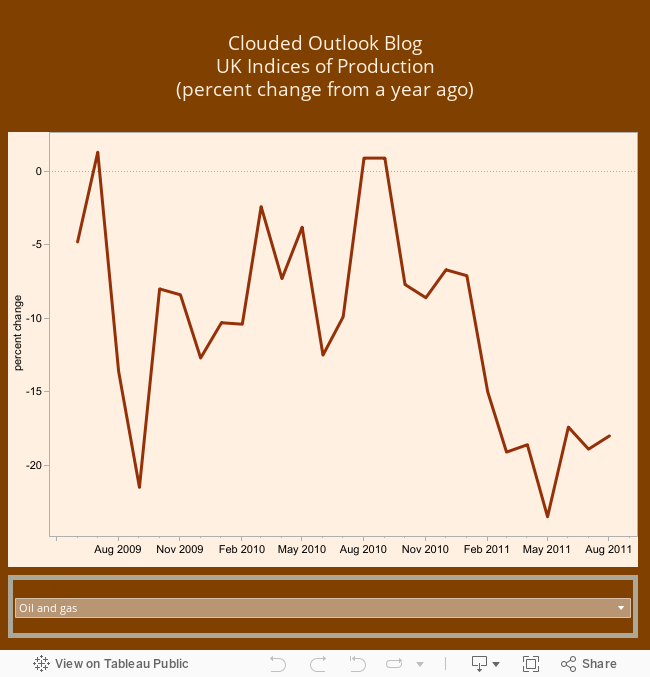
The headline index of production, so are other key sectors, such as capital goods. Other sectors, such as intermediate goods, energy and oil and gas are actually shrinking.
More evidence of an oncoming recession.
Friday, September 30, 2011
The rich are more fearful than the poor
According to an ONS survey, over 90 percent of households earning more than £100,000 a year think the global economy is in bad shape. The poor - those earning less than £20,000 year - don't seem quite so concerned. Just over 75 percent think the world economy has gone to the dogs.
Which is better; to be rich and fearful or poor and complacent?
Friday, September 23, 2011
A genuine exit strategy from the crisis
In 2010, the global economy enjoyed steady if unremarkable growth. By the third quarter of 2011, it teetered on the edge of recession. The post-crisis recovery lasted barely 2 years. Moreover, in many advanced economies, growth proved insufficient to ensure that GDP reached its pre-crisis level.
How did things get so bad so quickly? The answer lies in the public sector balance sheets of advanced economies.
When banking sector difficulties turned into an economic downturn, tax revenues took a hit, while expenditures on unemployment benefits rose. In some countries, the revenue decline was exacerbated by a long-standing dependence on asset prices and financial bubbles as sources of taxes.
Politicians believed that they could buy their way out of recession. With revenues already weakening due to the economic downturn, governments tried to stimulate activity by cutting taxes and increasing expenditures, pushing fiscal deficits up to levels not seen since the Second World War. With rising deficits came rising debt levels, which were already extremely high in many socialist leaning European countries.
Thursday, March 10, 2011
Taming the CAP monster
At last, European governments have begun to tame the Common Agricultural Policy. There was a time when this insane subsidy for farmers would spin out of control, consuming ever increasing amounts of public expenditure.If you will pardon the pum, recent reform efforts have bourne fruit. In euro terms, expenditures on financial support to agriculture has been flat since the mid 1980s. Over the last five years, expenditures have actually fallen in nominal terms.
The CAP continues to consume about 80 billion euros a year. This number is still far too high. Nevertheless, the recent fall in expenditures shows that even the most deeply entrenched subsidies can be dismantled if the political will is there.
Wednesday, March 9, 2011
Great shot
Libya's main oil terminal was in flames on Wednesday night after Muammer Gaddafi's airforce bombed the complex, in an escalation that pushed the cost of the benchmark Brent above $115 a barrel.
Libyan oil wasn't the only thing destroyed by Ghaddafi's planes. The Bank of England's inflation forecasts also took a direct hit.
The Treasury proposes a new framework for financial regulation
The Treasury has just produced a paper outlining a new framework for financial sector regulation. The paper proposes three new innovations:
Tuesday, March 8, 2011
Young men exit the labour market in record numbers
The last decade might have been boomtime for bankers, but for many young men, it was a very lean period. Labour force participation rates for 16-24 year old males fell by around 7 percent. Before you ask, that number excludes those in full time education.The decline in participation seems to coincide with the election of Blair, Brown and the New Labour crew in 1997. During the latter years of the Major goverment, participation was actually increasing.
The recent recession appears to have accelerated the process of male youth economic inactivity. Last year, the participation rate fell dramatically
Here is a question - how are those inactive young men surviving? Perhaps, they are all safely at home with mum. Or perhaps not.
Unprovable counterfactuals
Economic policy over the last two years was one huge Keynesian experiment. The fiscal deficit was pumped up, allegedly to prevent an apocalyptic depression. Can we see any evidence that this massive fiscal expansion had any practical impact on economic growth? In a word, no.Despite this historically unprecedented policy intervention, real GDP collapsed in 2008. For six straight quarters, the economy contracted. There was a modest and decidedly anaemic recovery last year. Nevertheless, the economy remains about 4.5 percent smaller compared to its previous peak.
Monday, February 28, 2011
Andy Sentance explains why rates have to rise
Andy Sentance lays out the case for a rate rise in a recent speech entitled - Ten good reasons to tighten:
Perhaps the UK economy is really slowing down again
The Q4 GDP number looked like a weather-generated aberration. My view, for what it is worth, was that the UK economy would recover quickly this quarter. While I thought growth would continue to be anemic, I also believed that the UK GDP numbers would crawl into positive territory.
However, a couple of recent stories have recently made me reconsider this optimism.
Thursday, February 24, 2011
RBS exercises restraint
First the bad news. RBS chairman - Sir Philip Hampton, conceded that last year more than 100 employees received compensation of at least £1 million. The good news is that the number was lower than the preceding year.
There is even more good news - bonus pool was less than £950 million. It could have been so much higher.
Stephen Hester, chief executive, summed it up perfectly "We have tried to exercise restraint."
There is even more good news - bonus pool was less than £950 million. It could have been so much higher.
Stephen Hester, chief executive, summed it up perfectly "We have tried to exercise restraint."
Rates must go up
Andrew Sentance, MPC member, again called for higher rates in the face of growing inflationary pressures:
Six months ago it might have been possible to gradually increase interest rates. Unfortunately, the Bank of England is so far behind the curve that only a sizable rate hike will have a significant effect on rising prices.
"The time has come to increase interest rates. We should increase them gradually and slowly if we can. But the risk of delaying interest rate rises too long is that this gradual approach may cease to be an option in the future."
Six months ago it might have been possible to gradually increase interest rates. Unfortunately, the Bank of England is so far behind the curve that only a sizable rate hike will have a significant effect on rising prices.
Wednesday, February 23, 2011
The MPC are digging up old quotes rather than hiking rates
The monetary policy committee has started to communicate in aphorisms. Both David Miles and Adam Posen cracked open a dictionary of quotes in order to spice up recent speeches on the state of UK monetary policy.
The tyranny of debt dynamics

Debt charts can often scare the crap out of you. If the line heads upwards, dark images of financial ruin and bankruptcy come to mind.
David Miles, external MPC member, produced this alarming picture in a recent speech. It highlights the UK debt-to-GDP ratio since the middle of the 19th century. If one includes the debts of recently nationalized bank, the current debt to GDP ratio stands at 150 percent. It must have had the audience nervously searching their handbags for the Valium.
Actually, that number is a little too alarmist. There are assets that one should place against those bank liabilities. The real level of public sector indebtedness is closer to 70 percent. Still, there is something shocking about that number. In the space of three years, the public sector debt has doubled as a percent of GDP.
Monday, February 21, 2011
What is the trigger rate for inflation?

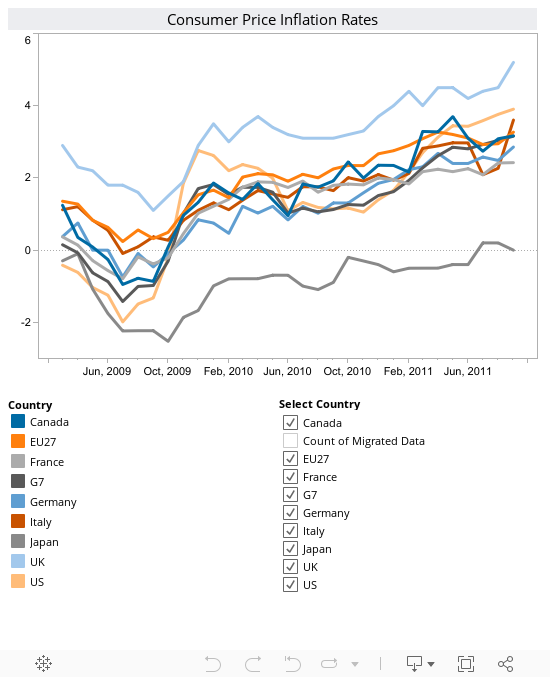
At what rate of inflation would the monetary policy committee feel compelled to raise rates? It is certainly not four percent. We are there already and rates remain firmly fixed to the floor. Would it be five percent? Seven? Eleven?
There must be a number - a trigger inflation rate - where the MPC would finally act; a point where the costs of rapidly escalating prices are greater than any gains from protecting the banks and trying to revive the economy with cheap money.
Sunday, February 20, 2011
Single mums and corporate welfare
Welfare dependency isn't just confined to the inhabitants of our inner-city sink estates. Corporations also do nicely out of government largess. Unfortunately, corporate welfare was more difficult to detect than the stroller-pushing single mum in the high Street.Nevertheless, things changed radically last year. Shortly after the election, the new coalition instructed ministries to publish data on expenditure over £500. We now hae extraordinary database that reveals in startling clarity that many firms now depend on handouts from the government.
Take, for example, the Ministry of Energy and Climate Change. Between September and November last year, the Ministry handed out almost £60 million in grants to private sector firms.
Bishop Theophilus is innocent
In a recent speech, author Philip Pullman compared the eagerness of some local authorities to close down public libraries to the Bishop Theophilis who Pullman claims destroyed the Great Library of Alexandria.
“The government, in the Dickensian person of Mr Eric Pickles, has cut the money it gives to local government, and passed on the responsibility for making the savings to local authorities. Some of them have responded enthusiastically, some less so; some have decided to protect their library service, others have hacked into theirs like the fanatical Bishop Theophilus in the year 391 laying waste to the Library of Alexandria and its hundreds of thousands of books of learning and scholarship.”
Philip Pullman's reference to Theophilus is obscure. Did the fanatical Bishop really burn down the library at Alexandria? These days, it is possible to verify faux intellectualism with a quick search on Wikipedia. It would appear that Pullman unjustly maligned the poor Bishop.
Subscribe to:
Posts (Atom)